I couldn't be more proud. Now I just need to find someone who can let out my tuxedo pants.
One single gay man's experience, leaving corporate America and retiring early in San Miguel de Allende, Mexico.


We had it. The Flu that is, about a month ago. We didn’t know it at the time.
Rod had just returned from a 10-day dog show in
His client was the first to get sick. He turned ill almost immediately after arriving home. A few days later, as he was on the mend, I got slammed.
Typical nausea and diarrhea, fever and chills, I was curled up in a ball for a day. I called Rod and asked him pick up electrolytes on his way home from work. Then came the headache. For two days I wanted to die.
Then it was gone. Really only three bad days.
Rod’s client’s case moved into pneumonia and she tested positive for H1N1. That’s how we know we had it even though we never tested.
Everyone is fine now and funny enough, glad we got it out of the way. Now we don’t have to worry about getting it nor face all the controversy about getting the shot.
Best of luck to y'all. But if you ask me, it was milder than other flu's that I've had. If you get it, stay in bed and keep hydrated. It will probably be over before you know it.
Our good friends and neighbors are a Mexican-American family with a ranch about five minutes from our house. The Mexican side of the family has owned and operated the ranch for generations. About two years ago, as part their efforts to convert the property from traditional crops to more “green” agriculture, they planted a vineyard. So when Diane emailed me and asked if I’d be willing to help with the first harvest of the season, I jumped at the chance.
She suggested that I round up a picking partner so I immediately called Alex. Despite the fact that we were to start at 8:00 in the morning (and Alex is not a morning person) I thought he’d enjoy the experience given that he has such appreciation for mother earth and the growing of things.
As I presumed, Alex agreed. However, given the daunting idea of rising so early, Alex thought it a good idea that he spend the night at our house so that the responsibility of waking up so early could be shared. That night we had one of our best rain storms of the season.
The next morning we were having our coffee and tea on the patio before departing. “Wow,” Alex said, “Mornings are really beautiful. Not so much that I’d give up my nights, but beautiful nonetheless.”
“That’s what siestas are for.” I said. “Then you can experience the best of both.”
Armed with our pruning sheers, buckets and rubber boots, we set off for the vineyard.
Once we arrived and Diane gave us our picking instructions, we were designated a row and set to the task. It was beautiful. The morning was bright and clear, rain drops still clung to the vines and the dark purple grapes. Shortly into the effort Alex found a humming bird nest with three tiny eggs. So as not to disturb the nest, we spared the ripe grapes that surrounded it.
As my bucket filled and I trudged down the row, the task became more difficult; primarily because with each step I managed to collect another layer of mud on my boots. They were getting heavy. I was probably pulling an extra five pounds with each step. “You know,” I said over the top of the vines, “In the U.S. we use Mexicans to do this work. Funny that here you use Americans.”
At that Higinio, the father, yelled “Immigration!” and his son Eric added, “Papers please!”

All in all, there were about 20 of us participating in the harvest. We picked cabernet sauvignon, cabernet franc and tempranillo, about 200 kilos in all. (We took a look at the Grenache but it wasn’t ready.) We suspect that there is probably about three times that amount yet to ripen in the coming weeks.
The grapes were handed over to a Mexican family from neighboring
The first harvest was completed by 11:30 AM. With a nice mid-morning buzz from the wine tasting, I set off home for a two hour siesta.
Back in Pátzcuaro we dined, at the recommendation of a friend, at Cha Cha Cha. The owner is from the San Francisco bay area and he explained that he prefers Pátzcuaro to San Miguel because there are more trees and fewer gringos. And with Morelia only 45 minutes away, he has the best of country and city life. (I want to go back and explore this further.) He also said that Morelia has a hopping gay scene.
The next morning Toby whipped out his guide book and I whipped back. Enough time in the car. I want to explore Pátzcuaro. I want to go to the island in the center of the lake.
Down at the pier we buy our tickets and are ushered into a long narrow boat with an outboard engine. Accompanying us are the locals, laden with bags of potatoes and vegetables to take to the island. A sign says that the boat’s capacity is 80 people. (I wonder how many bags of potatoes that includes.) The indigenous people appear more native; smaller, darker, less European blood if any. They still wear traditional dress with bright embroidered skirts, aprons and puffy blouses. A young woman breasts feeds an infant while chatting with a wizened grandmother. The language spoken is not Spanish. I notice only one other tourist. A young woman reading a book, who might be beautiful if not for the pierced lip and dreadlocks.
The boat trip is about 30 minutes. The lake is huge, dirty but not disgusting. Our boat stops while the fishermen paddle out and perform something of a show with their unique butterfly nets. After the brief show they paddle over to our boat for tips.
On the island we hike to the monument at the top. There are a multitude of little shops and food vendors but many are closed. We are not there at peak tourist season. Peak tourist season is for Dia de los Muertos (or Day of the Dead) when the island swarms with visitors.
The island at Pátzcuaro
Back by the boats we sit in a restaurant but only order cokes. We don’t feel good about the food being served on the island. We’ll wait until we get back to town.
Back on shore we share a taxi with a charming Swedish woman who was there doing some kind of research (I don’t remember what kind). After dropping her off we find a restaurant on the square and order lunch. A man with a booming baritone voice serenades the diners for tips and offers to sell us his CD. He was good but we don’t buy a CD.
The baritone should have stayed. Because he is replaced by a boy with a guitar, who plays a single cord (if it can be called a cord) and sings at the top of his lungs some song having no relation whatsoever to the so called cord. It is painful. He is so bad that it is comical. At the table next to us is a small child in a highchair. She is adorable. (She looks just like “Boo” in the movie “Monsters Inc.”) She is twisted around in her chair staring at the singer, with a look of distinct horror on her face that clearly says, “What the fuck is that noise?” (I still regret not taking a photograph of such an adult expression on such a young face.)
Our trip back took us through Morelia again. We stepped it up a notch and stayed at the beautiful Hotel de la Soledad (http://www.hoteldelasoledad.com/english.htm), only a block from the main square. That evening as we walked to dinner, minstrels and clowns were performing for the crowds in the square.
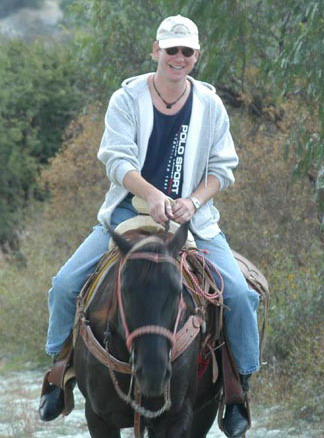
The next morning we set out for the butterfly sanctuary, famous for the millions of monarch butterflies that breed and nest before returning to Canada in the spring. After hours of driving we came to the sanctuary. What Toby’s guide book didn’t mention was that it was a three hour hike to where the butterflies were actually nesting. This didn’t do with our schedule which was to put us in Queretaro that evening. Again, there were the horses. We explained to our guides that we didn’t have the time to hike so we would ride. What surprised us was that our guides were not on horseback but ran along beside us. They took us down sheer cliffs and through deep ravines. When going uphill, they would hang onto our horses’ tails.
It was a cloudy day and although we could see masses of butterflies hanging on branches, some of the impact was lost because of the low light. Instead of bright orange clumps, we could only see dark, packed branches. It began to rain. On our way back we passed a couple hiking in, not far from the start of the trail. “I think it’s just a littler further.” I heard the man say in English. “Oh,” I thought, “You have no idea.”
One important lesson that we learned on our trip was, if you are touring a site in Mexico and they offer you a horse, take it.
For those who fear the idea of driving in Mexico, let me stress that the roads were wonderful nearly every place we traveled. There were no bandits by the side of the road and at no time did we feel unsafe. People were friendly and went out of their way to give us information or directions. In our short trip we saw several types of topography; high desert, pine forest and jungle. There were lakes, mountains and volcanoes. At times we were on long highways without anything but farm land or vacant countryside and hardly another car on the road. It gave me an appreciation as to how vast this country is and how little people (from the U.S.) know about it other than the beaches of Puerto Vallarta or Cancun. Believe me, there is a lot more to Mexico. And the further you get away from the tourist resorts, the better it is. For me anyway.